Costa Rica · Eco stay
Finca Bellavista: A Tree House Community in Costa Rica's Rainforest
Three kilometres of steep dirt track above the Pan-American Highway, a community of houses on stilts and in trees has grown out of a patch of forest once marketed for logging.
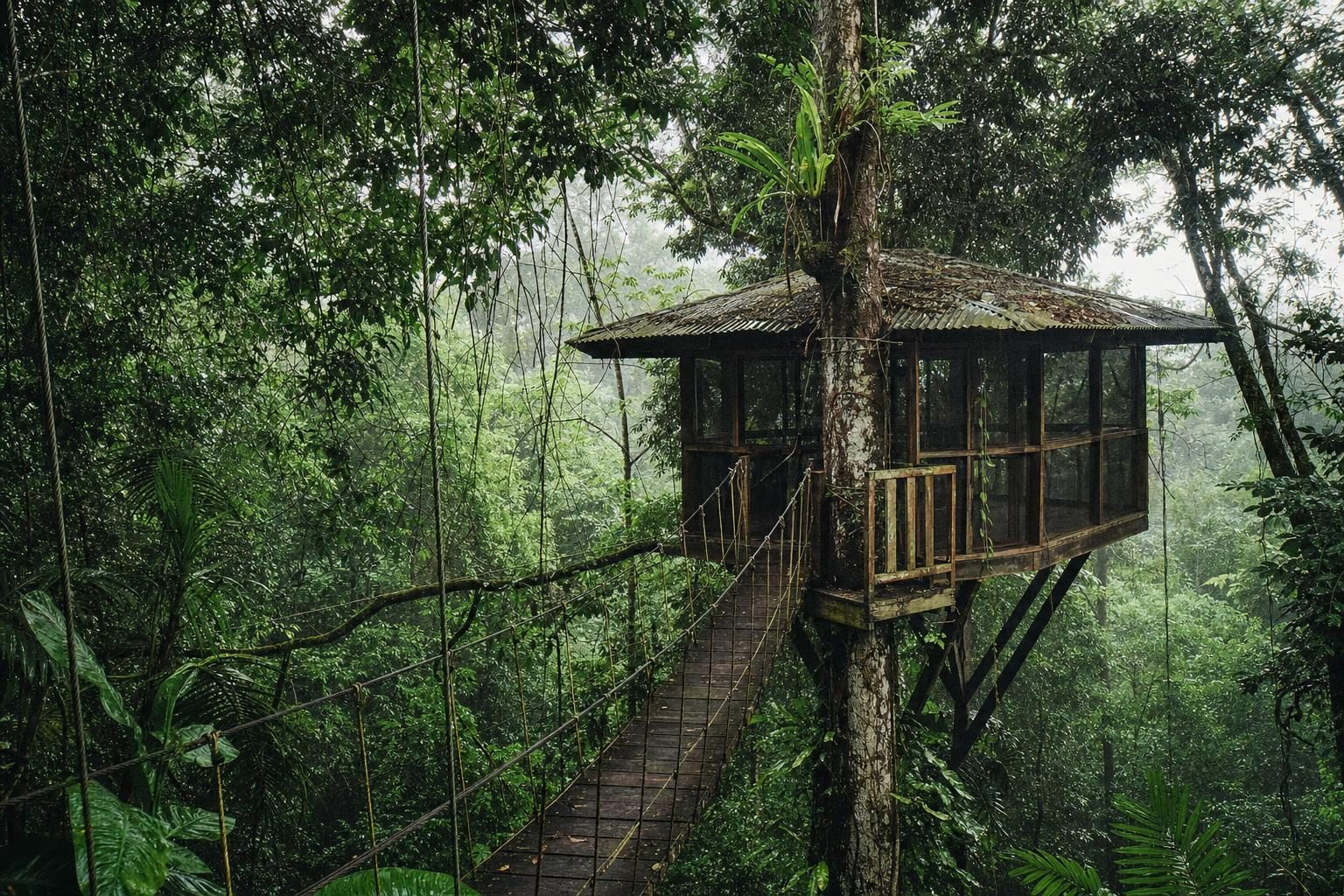
The last three kilometres are the test. After hours on the Pan-American Highway through the south of Costa Rica, the turn-off near Piedras Blancas leads onto a steep dirt track that climbs east into forest, and from there only four-wheel-drive vehicles go any further. At the top is Finca Bellavista, a community of tree houses and stilt houses spread across a rainforest ridge between two whitewater rivers.
It is one of the few places in the world where people own houses in the canopy and live in them, and where visitors can rent one for a few nights. The idea began with a 62-acre parcel of forest that, in 2006, was on the market as a timber harvest site.
Plan your visit
- Where
- Costa Rica's Southern Zone, Puntarenas Province, between Palmar Norte and Río Claro More
- Getting there
- Sansa flight San José to Golfito in about 50 minutes, then a 4x4 taxi of around 45 minutes More
- Getting around
- Cars stay at base camp; trails lead on foot to the houses More
- Season
- Drier from roughly December to April; wettest from about September to November More
Getting to the Southern Zone
Finca Bellavista sits in Costa Rica’s Southern Zone, on the Pacific side of the country, in Puntarenas Province. The nearest towns along the highway are Palmar Norte to the north and Río Claro to the south, and the regional hub is Golfito, a port on the Golfo Dulce. Across the gulf lies the Osa Peninsula and Corcovado National Park, and the protected forests of Piedras Blancas National Park lie close by, on the gulf side of the highway.
There are three main ways in.
- By air: Sansa flies daily from San José to Golfito in about 50 minutes. A 4x4 taxi from Golfito airport to the community takes around 45 minutes.
- By car: From Juan Santamaría International Airport outside San José the drive takes five to eight hours, depending on traffic and stops. From the Panamanian border at Paso Canoas it is about 45 minutes north on the Pan-American Highway. Any rental car needs four-wheel drive.
- By bus: Tracopa buses leave San José for the south; passengers get off at La Florida or Piedras Blancas and take a 4x4 taxi up the final stretch.
The community advises against flying into Liberia, in the north-west, because of the long transfer.
Arriving at base camp
The track ends at the community’s shared base. This is where guests check in, where the kitchen and dining hall are, and where most of the social life happens. There is an open-air lounge, a bath house and an internet zone, and it is the natural meeting point for residents and guests at the end of the day.
Beyond base, cars are left behind. Motor vehicles were barred from most of the property from the start, and the founders planned for people to move around on foot, by bicycle and along zip lines. Trails lead from the centre to the houses, some only a few minutes away, others a longer walk down towards the rivers. Luggage that seemed reasonable at home can feel heavy on a muddy slope in the rain, so packing light makes the first walk a lot easier.
A night in the canopy
The houses are all different. Every structure on the property must stand on stilts or be built into trees, and slab foundations are not allowed. Within that rule, each design depends on access, the trees available and the slope, and plans go through the community’s Environmental Review Board as well as the standard Costa Rican building permit. The developers recommend that new owners hire a botanist to check the health of the trees they want to build in.
Some of the early houses gave a sense of the scale: one had roughly 800 square feet of platform around a much smaller enclosed room, another about 1,600 square feet in all. Some are reached by bridges or long stairways. Many rooms are screened rather than glazed, so the sound of the forest is constant: insects in the evening, rain on the roof, and before dawn the roar of howler monkeys carrying across the valley.
That noise is worth a short side-track. Howler monkeys are among the loudest land animals in the world, and their calls can carry several kilometres through forest. First-time visitors often lie awake trying to work out what is making it. The answer is usually a troop of animals that weigh less than a large dog.
Off the grid, mostly
The community runs on its own systems. Power comes from a shared solar grid, with hydroelectric power part of the long-term plan. Homes must collect rainwater or tap the springs on the hillside, and all waste water is processed through biodigesters, which every owner is required to install. As is normal in rural Costa Rica, residents take their own rubbish and recycling out to town.
A biodigester is a simple piece of kit with a large effect on a hillside like this. Waste water flows into a sealed tank where bacteria break it down without oxygen, producing a treated liquid and a small amount of gas instead of the raw sewage that a basic septic pit can leak into streams. On a property whose water comes from springs on the same hillside, the requirement is less about green credentials than about keeping the drinking water clean.
Connectivity is better than many guests expect. The community centre has internet, and phone coverage has improved over the years, though the forest has a way of reminding people how much of their day was spent looking at a screen.
The forest around Finca Bellavista
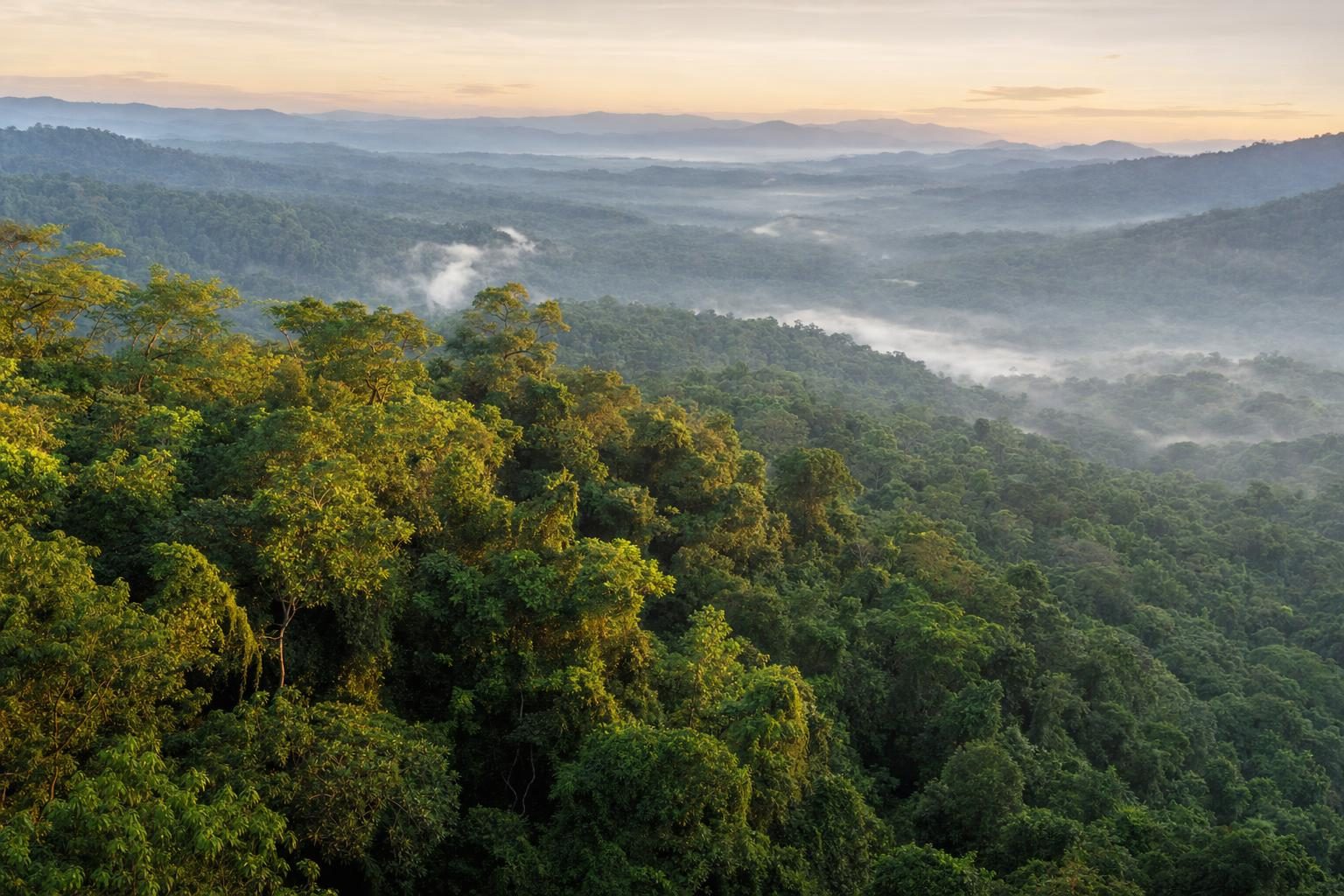
The land itself is the reason anyone comes. Finca Bellavista now describes its holding as close to 600 acres, including a forested mountain peninsula, frontage on two whitewater rivers, very large trees and organic gardens. About 140 acres are set aside for the residential community; the rest is forest. Much of it is secondary growth on land that was once logged or cleared for pasture, and the recovery is part of the attraction.
The southern Pacific forests of Costa Rica are among the wettest and richest in Central America. Visitors walking the trail network can expect birds such as toucans and tanagers, monkeys and sloths in the trees, poison dart frogs on the forest floor and an extraordinary range of insects. The two rivers at the edge of the property are the reward for the longer hikes.
The rains matter for planning. The wettest months on this coast generally run from about September to November, and the drier season from roughly December to April, though rain can fall at any time. Good boots, a light rain jacket and something to keep electronics dry are more useful than anything fashionable.
Beyond the ridge
Most guests spend a few days on the property and then use it as a base for the wider south. The region repays the effort of getting there.
The Golfo Dulce, the long inlet that separates the Osa Peninsula from the mainland, is one of only a handful of tropical fjords in the world: a deep, sheltered basin with a shallow sill at its mouth. Humpback whales visit its waters and the neighbouring coast in season, from both the northern and southern hemisphere populations, which gives this part of Costa Rica an unusually long whale-watching calendar. Dolphins are seen year-round.
From Golfito, small passenger boats cross the gulf to Puerto Jiménez, the gateway town for Corcovado National Park on the Osa Peninsula. Corcovado protects one of the largest remaining stretches of lowland rainforest on the Pacific coast of the Americas, and entry to its trails requires a licensed guide. Day trips are possible, but the park is best seen over two or three days with a night at one of its ranger stations.
South of Golfito the road runs out towards Zancudo, a long, quiet beach on the gulf, and Pavones, a surfers’ village whose left-hand point break is among the longest rideable waves in the world when a big south swell arrives. Neither is far in distance, though on the region’s roads every trip takes longer than the map suggests.
Back on the ridge, the evening is the same everywhere: the light goes quickly at this latitude, a little after half past five for much of the year, and the forest takes over the soundtrack.
Who lives here
Finca Bellavista is not a hotel. The land is divided into lots of two to five acres that are sold to private owners, who build their own houses within the community’s rules and often rent them out when they are away. In its early years owners came mainly from the United States and Canada, with a smaller group from Europe. A handful live on site year-round, while staff from the surrounding area run the guest operation, maintenance and construction.
The founders, Erica Andrews and Mateo Hogan, came from Colorado in the mid-2000s. Erica’s original picture was a tree house village like the Ewok settlement in Return of the Jedi. The story of how the founders turned that picture into a legal and financial structure is told in a separate profile, Mateo Hogan and the making of Finca Bellavista.
By 2016 the community was receiving around 5,000 visitors a year. If you want one of the more popular tree houses in the dry season, booking well ahead is sensible.
Rewilding, on a small scale
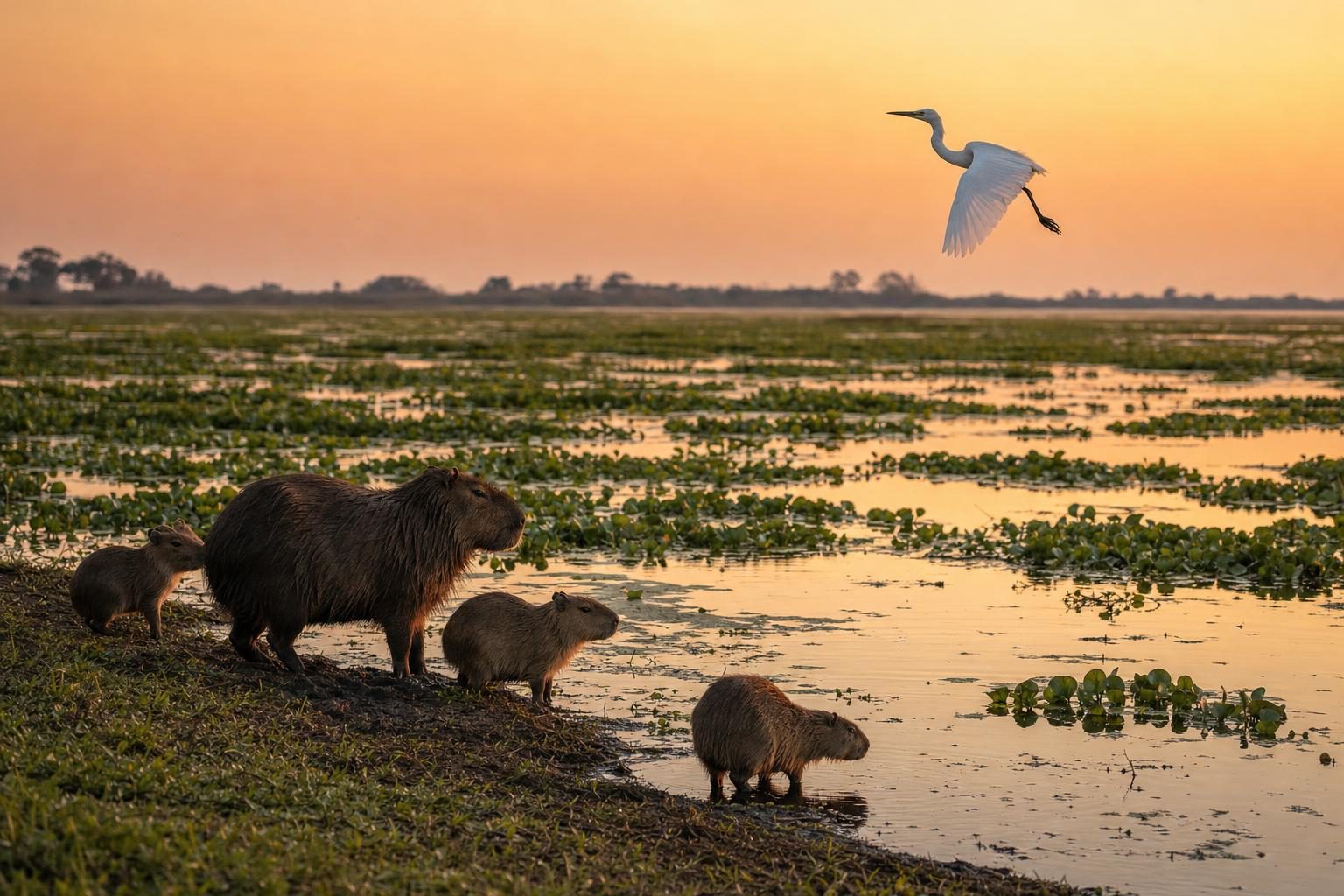
Finca Bellavista is one example of a wider pattern in conservation travel, in which visitors’ money helps keep land in forest rather than turning it to timber or plantations. On a much larger scale, the rewilding of Argentina’s Iberá Wetlands shows how far that model can go. At the other end of the spectrum, Singapore’s approach to the city in a garden brings the canopy into a dense metropolis rather than the other way round.
Here, the scale is a few hundred acres and a few dozen houses. Bookings, current rates and the trail map are on the community’s official website.
On the way out, the 4x4 grinds back down the same three kilometres of track, and within minutes the trucks on the highway drown out the howlers.
Questions before you go
Where is Finca Bellavista?
Finca Bellavista is in the Southern Zone of Costa Rica, on the Pacific side, in Puntarenas Province. It lies about 3 kilometres east of the Pan-American Highway near Piedras Blancas, between Palmar Norte and Río Claro, close to the Osa Peninsula and the Golfo Dulce.
How do you get to Finca Bellavista?
Most visitors fly from San José to Golfito with Sansa, about 50 minutes, then take a 4x4 taxi of around 45 minutes. Driving from San José takes five to eight hours. Long-distance buses from San José's Tracopa terminal stop at La Florida or Piedras Blancas, from where a 4x4 taxi climbs the final 3 kilometres.
Do you need a 4x4 to reach Finca Bellavista?
Yes. The last 3 kilometres from the main road are steep and unpaved, and the community asks that taxis, private transfers and rental cars all be four-wheel drive.
Can anyone stay at Finca Bellavista?
Yes. Many of the privately owned tree houses are rented to guests through the community's management programme, and it also offers packages and volunteer placements. Availability and rates are listed on the official website.
How big is Finca Bellavista?
The community describes its total land holding as close to 600 acres of rainforest, with about 140 acres set aside for the residential community. It began with a 62-acre parcel in 2006.
Is Finca Bellavista off the grid?
Largely, yes. Power comes from a community system based on solar energy, homes collect rainwater or spring water, and all waste water goes through biodigesters. The community centre has internet, and residents carry their own rubbish and recycling out.
Why are the houses built on stilts or in trees?
The community rules forbid slab and solid ground foundations. Every building must stand on stilts or in trees, which limits soil erosion and leaves the forest floor open for wildlife to move through.
What wildlife can be seen at Finca Bellavista?
The forests of Costa Rica's southern Pacific region hold monkeys, sloths, toucans and other birds, frogs, butterflies and many reptiles. Sightings vary by season and luck, and guided night walks are a common way to see the smaller animals.
What was the inspiration for the tree house village?
Co-founder Erica Andrews proposed a tree house village modelled loosely on the Ewok village in the Star Wars film Return of the Jedi. Co-founder Mateo Hogan worked out the logistics and the legal structure.